

What to do with crumbling Blue Lias in listed buildings
You have probably heard of Blue Lias, as it is one of Somerset’s most recognisable building stones. It appears across farmhouses, boundary walls and civic buildings throughout the county, and its distinctive blue-grey tones are part of the region’s architectural identity. And it can also be a demanding material to work with, especially when it starts to decay.
Recently MESH Consulting Engineers carried out a structural inspection at a Grade II listed farmhouse in south Somerset where the external Blue Lias stonework was showing extensive decay and delamination. The building dates from the early nineteenth century and is constructed in squared and coursed Blue Lias with solid stone walls approximately 450 mm thick. During our inspection we measured up to 40 mm of stone loss in places where the outer face had progressively delaminated over the years.
At first glance, weathering of this kind can appear to be a purely aesthetic issue. The colour of the stone – usually steely grey-blue – changes as it oxidises to a pale grey colour and then eventually weathers to a yellow-brown on exposed surfaces, particularly along joints.
In reality, these changes and the stone loss raise more complex questions about long-term structural performance, repair materials and how historic buildings should be managed within the conservation framework.
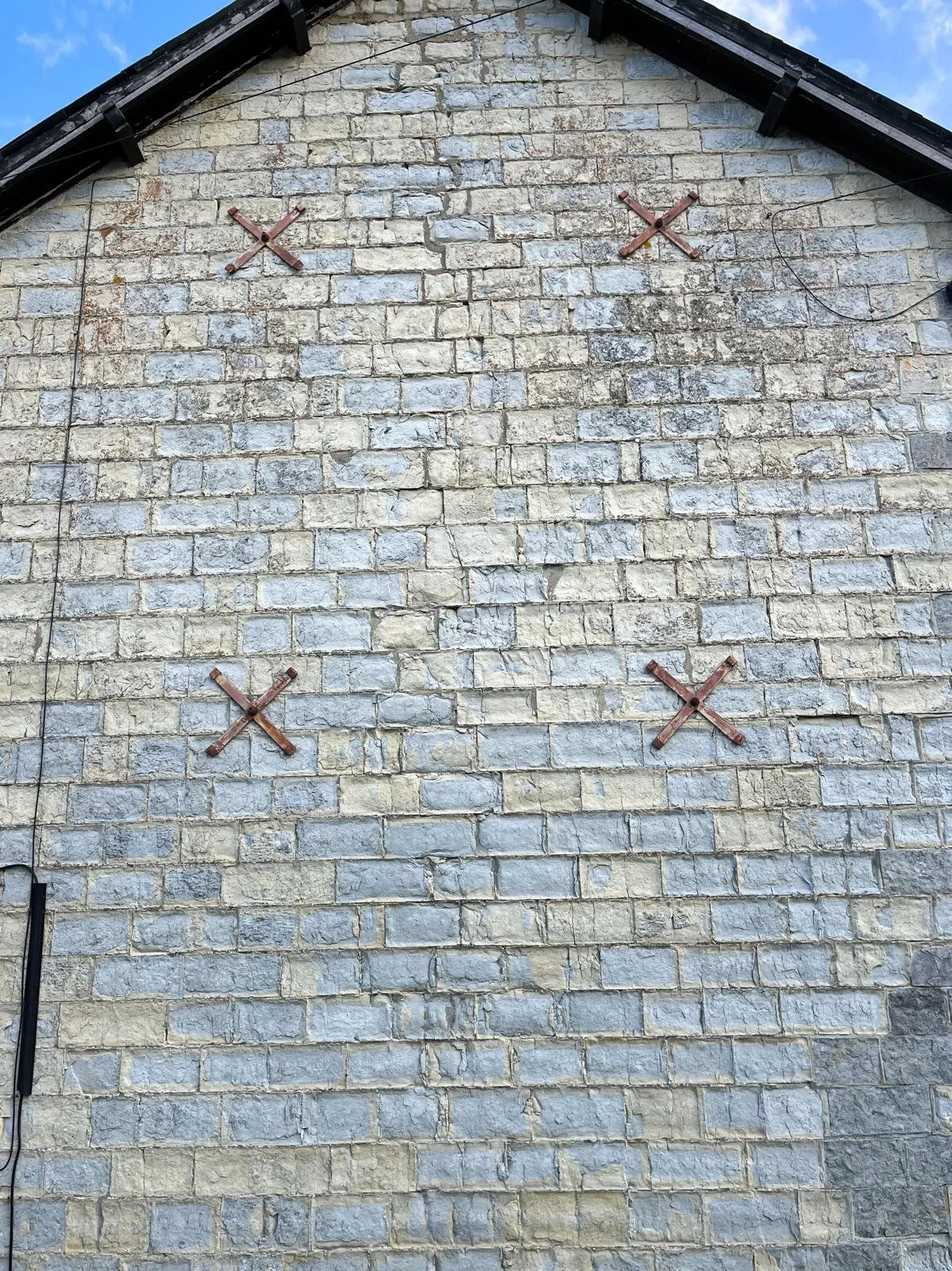
Gable end of listed Blue Lias Somerset farmhouse with signs of historic structural movement
Why Blue Lias can deteriorate in this way
Blue Lias limestone forms in thin horizontal beds. When used in construction, this stone ideally should be laid so those bedding layers remain horizontal. However, in many nineteenth-century buildings the stone was instead laid face-bedded, presumably for aesthetic reasons, meaning the natural bedding planes are vertical on the wall face.
Unfortunately, when this happens the layers begin to separate and peel away in sheets. CIRIA guidance notes that severe spalling can occur when sedimentary stone is laid in this orientation.
At this property, the delamination was particularly pronounced on the west elevation. The village sits within a zone of very severe exposure to wind-driven rain, which increases the rate of weathering. Together these conditions have created the patchwork appearance that can often be seen in Blue Lias buildings where freshly exposed stonework sits alongside weathered faces.
In the worst-affected areas, a loss of 10% of the wall thickness was measured. This continued decay will eventually raise concerns about structural stability.
The role of mortar in accelerating decay
We commissioned mortar analysis, which revealed another important factor. Two mortar samples were examined, one taken from the original nineteenth-century construction and another from repairs carried out in the 1990s.
The original mortar was a relatively weak hydraulic lime. This is generally quite typical of historic masonry construction. Lime mortars are softer and more permeable than the surrounding stone, allowing moisture to evaporate and enabling the mortar to act sacrificially.
The later repair used Portland cement mortar. Cement mortars are significantly harder and less permeable. Repointing mortars that are less permeable than the surrounding stone can accelerate frost damage and spalling. Hard mortar joints can cause the adjacent lias stone to weather more rapidly, particularly where moisture becomes trapped and salts crystallise within the stone fabric.
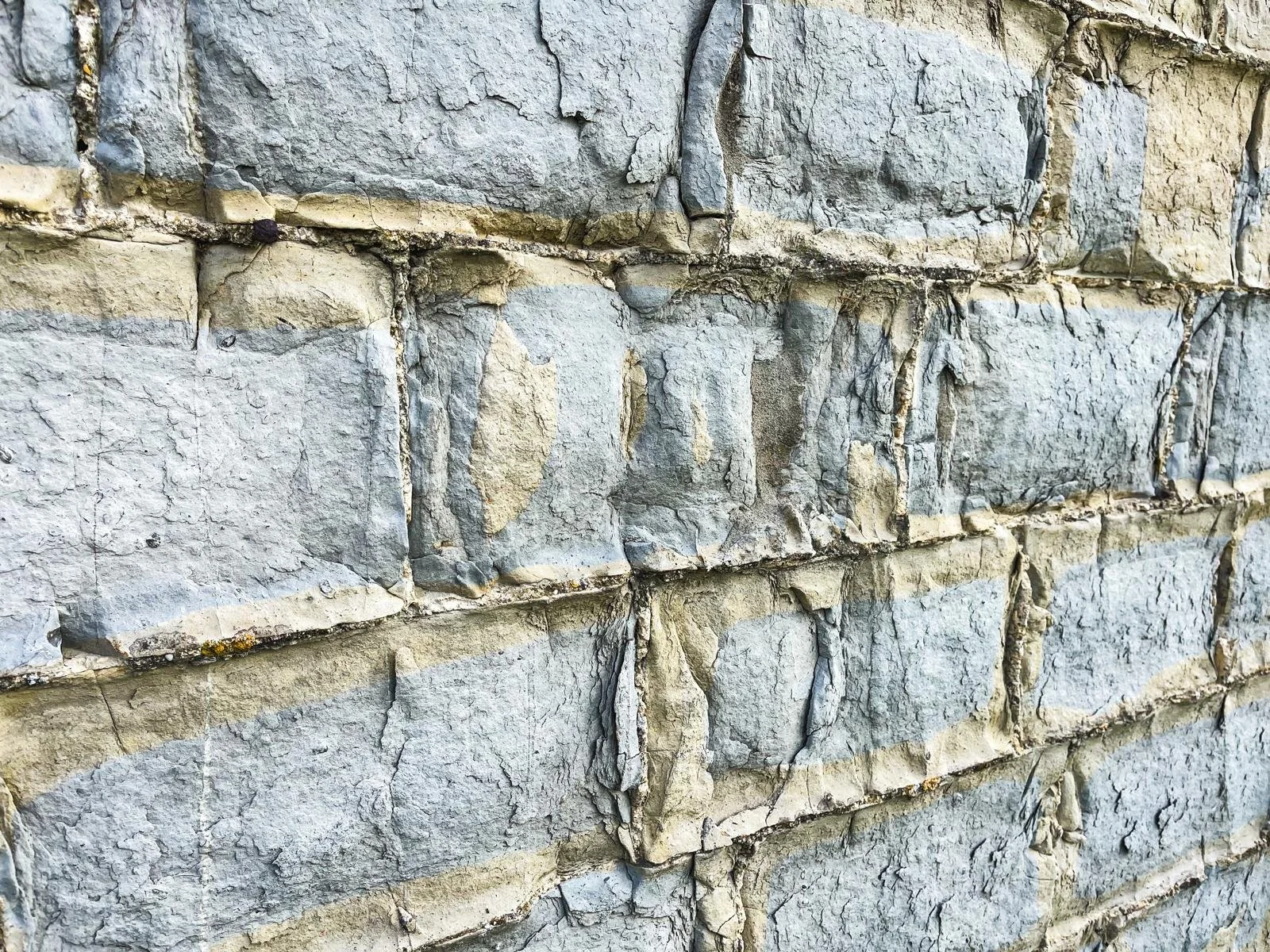
Blue Lias walls showing signs of delamination
Where conservation and structural priorities meet
This is where the discussion becomes more nuanced and solutions require careful decision making. The exposed Blue Lias masonry is part of the building’s historical significance. Somerset Council’s conservation team noted that the visible stonework, albeit deteriorating, contributes to the architectural interest and aesthetic character of the farmhouse.
The weathering patterns seen on many Blue Lias buildings are, to some extent, characteristic of the material itself. From a conservation perspective the stonework may appear to be weathering in a way that is typical and historically authentic.
Structural assessment can introduce a different lens (and one sometimes at odds with the conservation perspective). Stone loss cannot continue indefinitely without eventually affecting the stability of the walls. At some point, the decision becomes a choice between limited maintenance now or much more extensive rebuilding later.
Rebuilding sections of a listed Lias façade is rarely desirable from either a conservation or engineering standpoint. And our aim is always to preserve as much original fabric as possible.

Up to 40mm of stone loss measured
Maintenance rather than major intervention
Historic buildings often perform best when they are maintained using traditional materials and techniques rather than left untouched for long periods.
In the case of Blue Lias masonry, that typically means ensuring mortar joints remain softer and more permeable than the stone itself. Removing inappropriate cement repairs and reinstating lime mortar can significantly slow further deterioration.
Traditional protective finishes also play a role. Shelter coats or limewash have long been used as breathable sacrificial layers that protect friable stone from direct weathering while remaining reversible and compatible with historic fabric.
None of these measures are especially dramatic interventions that destroy the historic significance of the property. They are sympathetic forms of maintenance that allow the building to continue performing in the way it was originally intended.
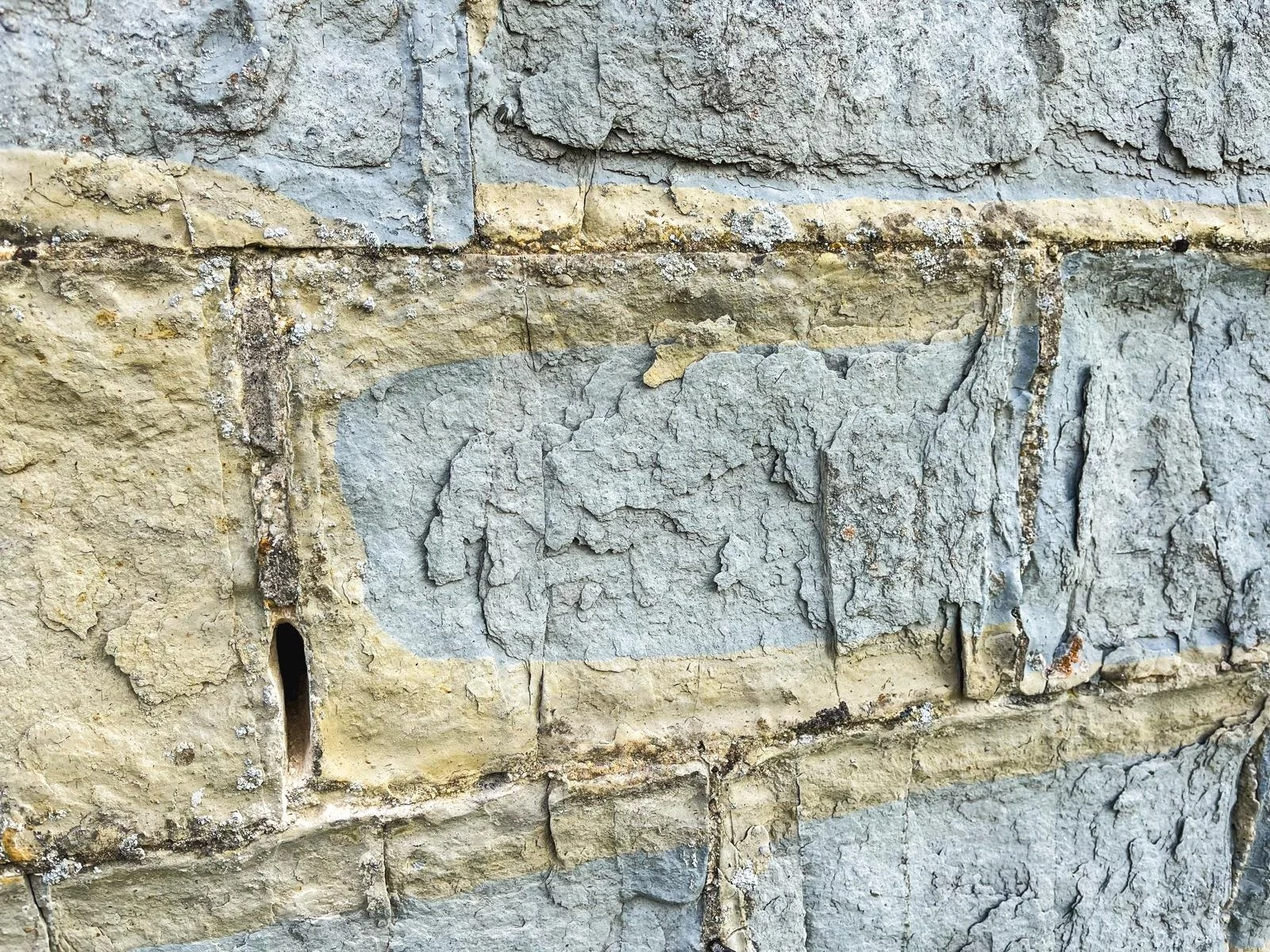
Mortar samples were taken for analysis
A shared responsibility
Projects like this highlight how closely structural engineering, conservation practice and the property owner need to work together. The aim is not to prioritise one viewpoint over the other but to recognise that historic buildings exist within both structural and cultural contexts.
Blue Lias is a beautiful material, but it is not maintenance-free. When it is laid face-bedded and exposed to severe weather conditions, it can become particularly vulnerable to delamination. Repair materials that are incompatible with the stone may accelerate this process, even when applied with good intentions.
The challenge is to recognise when natural weathering begins to move into structural risk and to respond proportionately, with care and understanding of the materials.
If you work with historic buildings in Somerset, you may well have encountered similar questions around Blue Lias or other traditional stones. These are rarely straightforward issues, and thoughtful discussion between engineers, architects and conservation professionals is often where the most balanced solutions emerge.
We’d love to read your thoughts about this. Maybe you’ve had experience working with Lias stone or have a property that you’re concerned about? Get in touch.