

Responsibility and risk when it comes to foundations
Recent proposals to reform England's building control system have reignited an important debate within the construction industry.
Following the Grenfell Inquiry, the Building Control Independent Panel (BCIP), chaired by Dame Judith Hackitt, published its final report on May 20, 2026. Since then, the Government has accepted the need for significant changes to how Building Control operates.
Among the proposals being considered are ending the long-standing practice of allowing clients to choose their own building control provider and creating a more consistent, publicly accountable system. The aim is clear: improve standards and strengthen accountability so they can rebuild confidence in the regulatory process.
We believe there are important conversations that are necessary right now around responsibility and risk, and whether the industry - particularly Engineers - actually needs more guidance.
You can't outsource judgement
Within the profession, there has been considerable discussion about foundation design and where responsibility should sit.
Historically, many domestic projects followed a familiar process. Foundations would be excavated and a local authority Building Control Officer, often someone with decades of experience of local ground conditions, would inspect the trenches before concrete was poured. Their (sometimes quite astounding) knowledge of local geology, historic developments and recurring ground issues was invaluable.
The industry has changed considerably since then, and good old capitalism has prioritised profit above all else.
Today, Engineers carry much greater responsibility for foundation design, while the Building Control landscape continues to evolve, and this shift has prompted debate about liability and professional duties. You can read more about the shake-up of Building Control here.
Without clear guidelines, we, as Engineers, are having to rely upon our experience and good judgement and hope that that’s enough.
Our work begins with good questions
I’ve said it before and I’ll say it again: Foundation design isn't an exact science.
Despite what people might imagine, there isn't a formula that simply produces the correct answer. Ta da!
Ground conditions vary enormously, even across a single site, and factors such as nearby trees, soil type and moisture content all play a role. Clay behaves very differently from other types of soil, and past performance does not always predict future behaviour, particularly as our climate continues to change.
Every foundation design therefore involves judgement, and that judgement should be grounded in evidence. In practice, this might mean digging trial holes to understand what lies beneath, commissioning soil testing where appropriate, or speaking to those with local knowledge of how similar sites have behaved over time. It may also mean pausing to carry out further investigation before committing to a design.
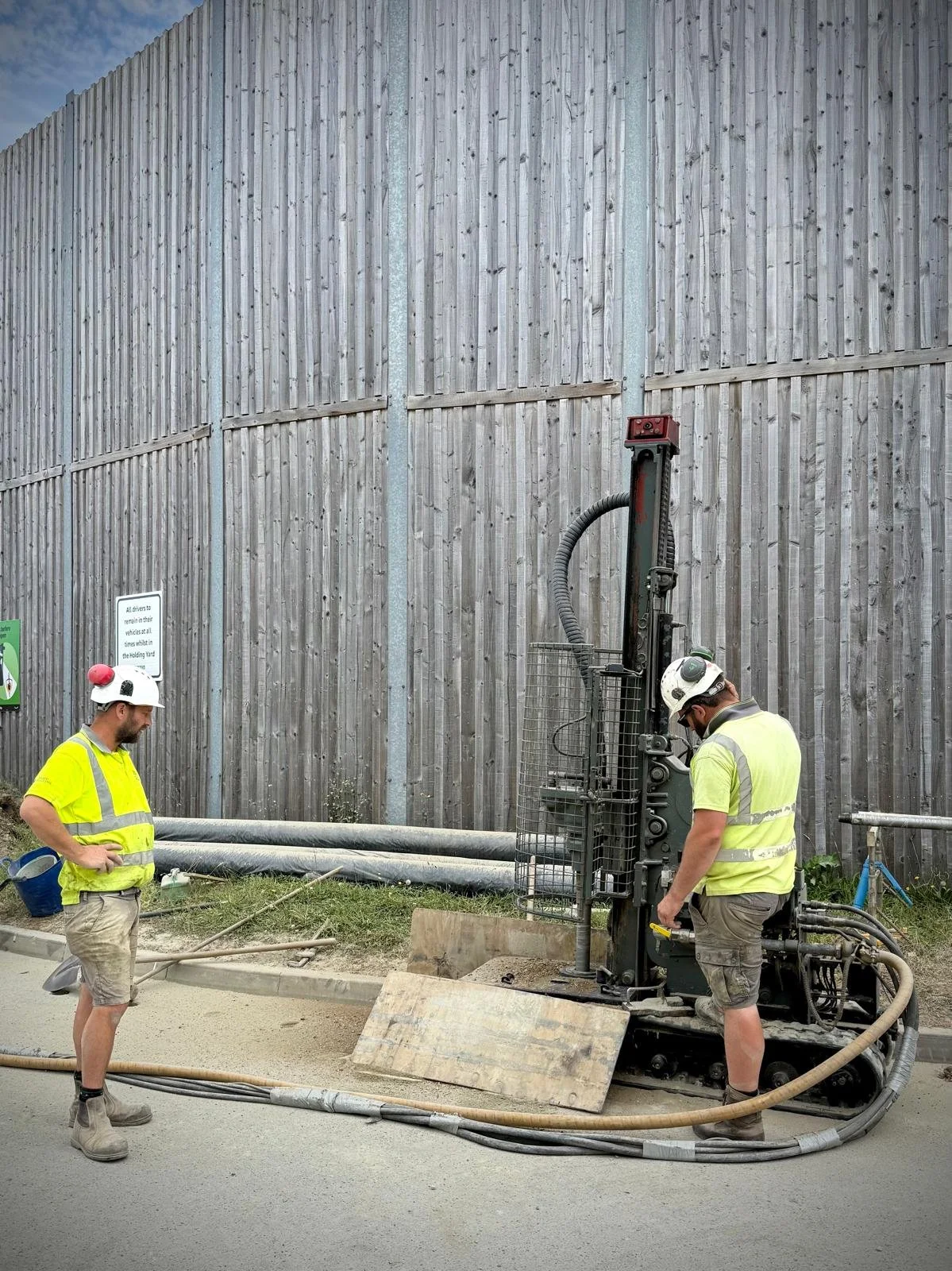
Borehole drilling ground investigation
What constitutes an appropriate level of investigation?
This depends on the project and the level of risk involved. There is little sense in insisting on a full geotechnical investigation for every modest domestic extension, just as it would be difficult to justify designing a substantial new building based on little more than assumptions about what lies beneath it.
For a typical domestic extension, we would usually ask for a trial pit so we can inspect the existing foundations and make a visual assessment of the ground conditions, surrounding trees and how the existing building has performed. On a new-build site, we might start with British Geological Survey data before deciding whether trial pits, soil investigation or laboratory testing are appropriate. Where the geology suggests poorer ground conditions, or the scale and risk of the project are greater, borehole drilling, ground penetrating radar or other specialist geotechnical investigations may be required.
The point is not to investigate everything to the maximum possible extent. It is to gather enough reliable information to make a proportionate, defensible engineering decision.
None of this is about avoiding responsibility. It is about recognising that good engineering depends on asking the right questions and doing thorough and appropriate investigation before settling on an answer.
Guidance is valuable and experience is essential
The engineering profession benefits from a wealth of guidance documents, design tables and technical standards, and these are tools we rely on every day. They provide consistency, support decision-making and help ensure that designs meet recognised benchmarks.
However, experience, curiosity and careful observation remain central to good engineering. They allow us to interpret guidance in context and to make informed decisions when the situation does not fit neatly within standard assumptions.
The difficulty is that there is not always clear, prescriptive guidance about how much investigation is enough. At MESH, we have developed our own procedures based on experience, proportionality and our assessment of risk. We believe they represent sound engineering judgement. We’re well known for our sensible approach.
But as regulations change and the allocation of responsibility shifts, there is a legitimate question for our profession: are individual engineering practices being left to interpret too much for themselves?
More practical guidance from our professional institutions would be welcome. Not to replace judgement, but to give Engineers a clearer framework within which to exercise it.
The temptation to pass the buck
There is a natural tendency to look for clarity about responsibility whenever systems and processes change. Questions arise about whether accountability sits with Building Control, the engineer, the contractor or the developer.
Building Control itself is going through considerable change. Recent proposals for reform sit alongside changes already affecting how responsibility and risk are apportioned across the industry. We are increasingly seeing Building Control make clear that they are not the designer and will not make decisions that properly sit with the engineer. On some projects, that now means Engineers being asked to attend during foundation excavations to inspect conditions that Building Control might have historically reviewed.
There is an understandable logic to that distinction. But for Engineers working on live projects, it creates a practical challenge. Regulations and responsibilities are evolving while our clients quite reasonably expect their projects to keep moving. We cannot simply put everything on hold while the industry works out where the lines eventually settle. We have to make sensible decisions now.
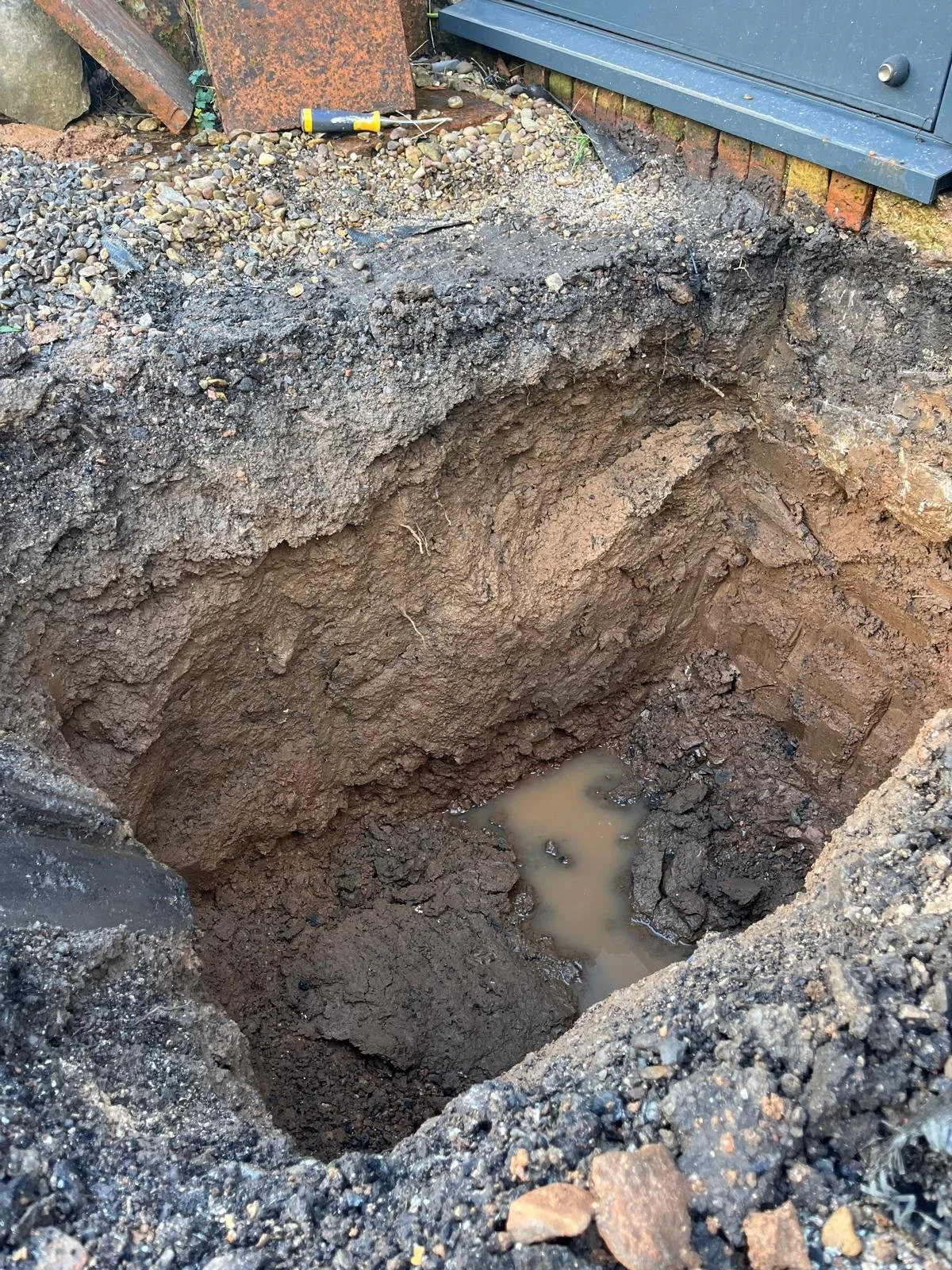
Hand dug trial pits can reveal soil conditions and water table levels
Risk has to be proportionate
Groundworks are inherently risky because, however much information we gather beforehand, we cannot see everything beneath our feet. The answer, though, cannot simply be to require the maximum possible investigation on every project.
A homeowner building a modest extension should not necessarily need the same level of geotechnical investigation as a major commercial development. Equally, cost cannot be the reason we ignore a genuine risk. Good engineering sits somewhere between those extremes: understanding the scale and consequences of the risk, gathering appropriate evidence and making a proportionate decision.
That may sound less reassuring than having a single prescriptive rule to follow. But engineering has always involved judgement. The important thing is that the judgement is informed, explainable and owned.
Climate change raises the stakes
This conversation is becoming increasingly important as environmental conditions evolve. Research from the British Geological Survey indicates that shrink-swell subsidence is likely to become more common as the climate changes, particularly in areas with shrinkable clay soils. This means that foundation designs must consider not only current conditions but also how those conditions may develop over time.
As such, our approach must adapt accordingly. This does not necessarily mean adopting more conservative designs across the board, but it does require a greater emphasis on investigation, understanding and informed judgement.
Engineers need to think carefully about how future conditions might affect the performance of the structures they design today.
Risk and responsibility are part of our job
Engineering has always involved uncertainty and some risk. The ground below a building is hidden from view and therefore often an unknown; structures are inherently complex; and, in our experience, no two sites are ever going to be the same. These realities are precisely why professional judgement is so important.
The current debate about Building Control is both necessary and welcome. The industry is changing and regulations and responsibility are too. As such, we believe clearer guidance would help Engineers navigate those changes consistently and confidently.
In the meantime, those of us doing the work on the ground have to keep making decisions. We have to decide when a trial pit tells us enough, when further investigation is justified, and when the level of risk demands something more.
We have to balance safety and responsibility with proportionality, practicality and cost.
Perhaps that is the conversation our profession needs to be having now. Not simply who carries the risk, but how we make sure the people being asked to carry it have the guidance, knowledge and support to make good decisions.
As always, you can rely on MESH Consulting Engineers for measured thinking when it matters most.