

Why Conservation Engineering is inherently sustainable
It’s World Environment Day, so we figured we’d share some of our thoughts and opinions about sustainability in engineering. Hills we would die on, so to speak.
When some people talk about sustainable construction and engineering, the conversation often focuses on new technology and progressing at speed. More efficient heating systems and insulation. “Smart buildings”. Low-carbon concrete. Intuitive solar panels. AI for engineering solutions…the list goes on…
And while the above may well be useful, of course, and perhaps even exciting to some, from both a Conservation and Structural Engineer’s perspective, one of the most sustainable things we can do is ever-so-much simpler:
Keep existing buildings standing for longer.

MESH Consulting Engineers work on the principle of repair where possible, understand before intervening, value and respect what already exists, and build for longevity
Why retaining existing buildings is more sustainable than demolition
At MESH Consulting Engineers, a significant part of our work involves historic and listed buildings. Conservation Engineering is sometimes viewed as a nerdy or niche specialism focused mainly on heritage, but in reality the philosophy behind it is deeply connected to sustainability.
If you are repairing structures rather than demolishing and rebuilding them, you are automatically reducing waste, reducing the demand for new materials and retaining the huge amount of embodied carbon already locked into the building. That matters more than people sometimes realise.
There is an enormous amount of energy stored within existing buildings. Think about all the quarrying of stone, the firing of bricks, the energy to fell all the timber for frames. Then there’s the transporting of materials (while often local, still energy consuming!) and actually constructing the building in the first place. Once a structure is demolished, all of that embodied carbon - all the energy that went into building it - is effectively written off.
When we’ve had conversations about this with people in the past, they’re quick to point out that demolition materials can be recycled. This is true to an extent, but recycling itself consumes large amounts of energy. Reprocessing materials, crushing masonry, manufacturing replacement materials…none of it is environmentally cost free.
That’s exactly why Carl Elefante said “the greenest building is the one that already exists”.
Conservation Engineering and the principle of minimum intervention
There is a tendency within the industry to assume that new automatically means better. If a building is cracked, leaning slightly or showing signs of movement, the instinct can be to strip it back, replace it or rebuild it entirely.
But we understand that buildings move. Old buildings especially. Movement is not necessarily evidence of imminent failure. Part of the role of a Structural Engineer is understanding the difference between movement that is historic and stable, and movement that genuinely requires intervention. That takes time, expertise, and experience. It also requires a certain amount of discipline and restraint.
Conservation Engineering is built around the principle of minimum intervention. That does not mean doing nothing, and it certainly does not mean being careless. In practice it often means the opposite: investigating carefully and thoroughly understanding the building and its construction before deciding what is actually necessary.
Sometimes that involves drilling into timber to understand the depth of decay. It might mean lifting loose stonework, sticking your head behind and working out what’s really going on. And occasionally it means monitoring a crack over time rather than immediately recommending expensive structural solutions. I believe that being inquisitive is a huge part of the role.
Because the aim of our work is not to avoid intervention altogether, it is to avoid unnecessary intervention.
And, at least for me, that distinction matters environmentally as well as structurally.
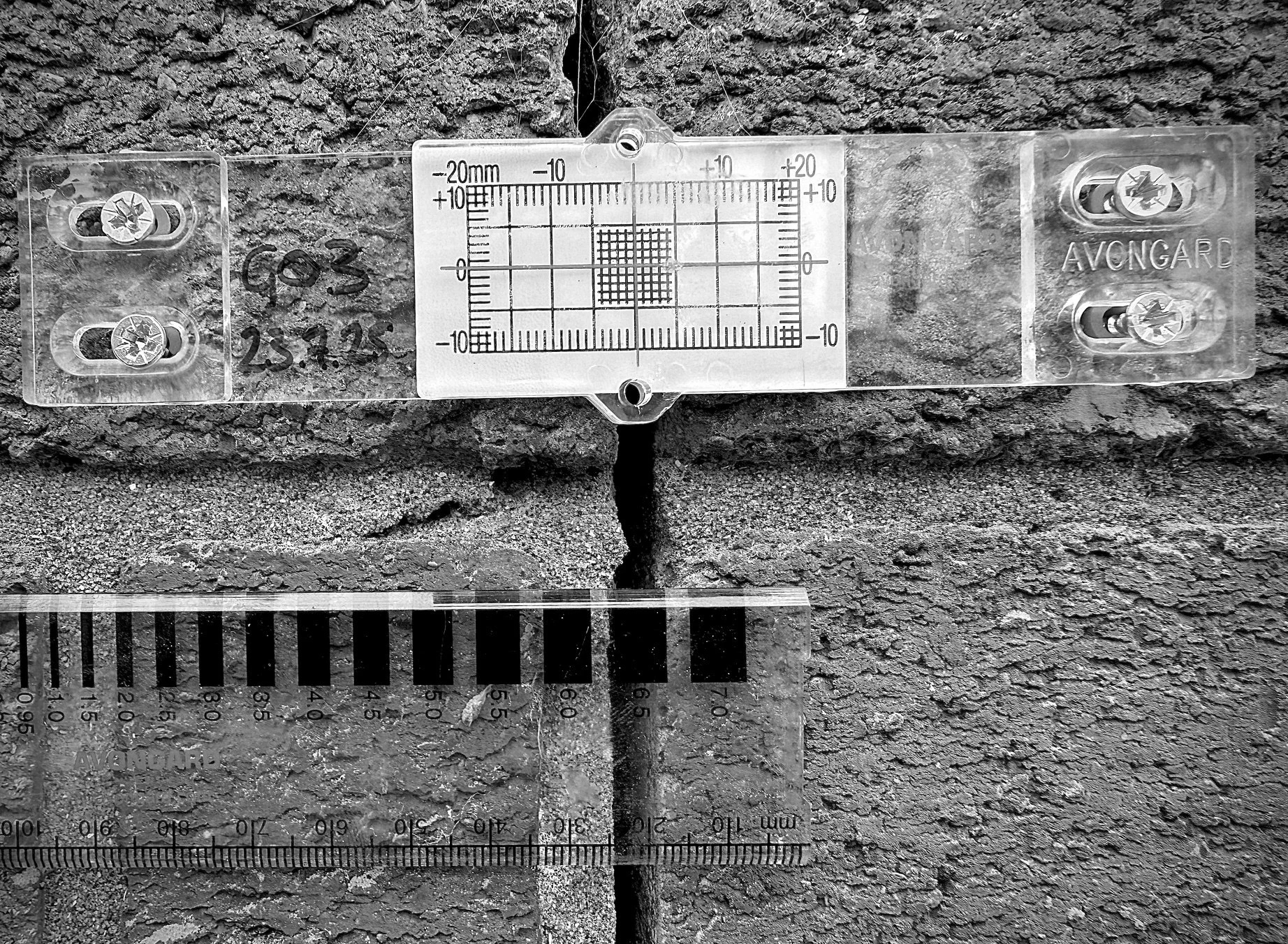
Monitoring cracks over time to understand what’s really going on
Avoiding over-engineering in structural design
Over-engineering can be a real issue within the industry. Structural solutions are sometimes specified that are significantly stronger, heavier or more invasive than they need to be. In some situations, that is unavoidable. Large openings, for example if someone wanted bi-fold doors put in, it would genuinely require substantial steelwork if deflection is going to be controlled properly.
In many cases, thoughtful engineering and an understanding of the original structure and materials can avoid replacement.
For example, we recently worked on a Grade II listed Victorian terrace in Bath that had experienced significant roof spread and wall movement, likely linked to historic land instability nearby. In fact, there were devastating landslides between 1865 and 1883, caused by steep terrain and inadequate drainage, leading to the loss of over 135 homes. Despite that information being readily available, a previous engineering proposal had recommended extensive rebuilding, which the Conservation Officer wasn’t impressed by.
Instead, MESH designed a system of discreet steel tie-rods and reinforcing bands that stabilised the structure while retaining the historic fabric and original roof structure.
That approach used less material, generated less waste and preserved the building’s character and significance.
What historic buildings, materials and methods can teach us about sustainable construction
Historic buildings also have a great deal to teach us about durability and materials.
Traditional construction methods often worked with natural movement of the earth rather than trying to eliminate it entirely. Lime mortars are flexible and breathable. Timber frames accommodate seasonal change. Buildings were frequently constructed using local materials with relatively low embodied carbon by people who understood exactly how those materials behaved.
Modern construction has become very efficient at building quickly and building strongly. But there is a legitimate question about longevity. Some historic buildings have already lasted several hundred years. It is difficult to say with confidence that many contemporary buildings will do the same.
There is also a risk in assuming that modern replacement materials are always equivalent to traditional ones. Replacing handmade brick with modern machine-pressed brick, or historic local geological stone with reconstituted alternatives, can create long-term problems because materials weather differently and absorb moisture differently. Repairs that initially appear sensible and sufficient can accelerate deterioration of the surrounding fabric over the next 20 to 30 years.
Conservation Engineering is about stewardship of buildings but also skills
Listed buildings are often described as being held “in trust”, safeguarding them for future generations, but there is probably value in applying that mindset more broadly. Buildings represent enormous investments of labour, materials, energy and skill. Demolition should not be the default response simply because something is old, inconvenient or imperfect.
And while the buildings are important, I would also like to think that the skills for working with traditional materials and historic buildings will be preserved and passed on. We are doing better these days, looking after historic buildings. That is good policy – Heritage buildings getting listed, forcing people in our industry to retain the skills to look after these materials and look after the buildings.
There are currently fewer people who know and understand traditional methods and materials. So if it’s policy to retain these buildings and repair them in a sympathetic way, it means these skills will continue. That knowledge matters, doesn’t it. We need to invest in it to keep it alive.
The future of sustainable Engineering
In my experience, the industry is getting better at talking about embodied carbon and whole-life cost. Awareness has improved significantly over the last few years. But behaviour has not changed at the same pace.
Honestly? It would be nice to see a future where demolition is treated as a last resort. (Read our blog on VAT savings on demolitions rather than restoring here.)
It’s a bit like me and you recycling - washing out all our plastic milk bottles - but actually it would be better if everyone had milk delivered in glass bottles. Not many people choose that option. It used to be the only one.
Which is to say, change has to be driven by the decision makers. It can’t just be left to people on the ground to have integrity. Most people are motivated by money - we’re living through late-stage capitalism after all - so it’s the policy that needs to change.
For meaningful change to happen, sustainability has to become part of decision-making at every level, from policy and planning through to design, engineering and procurement.
Stating the obvious here, but Conservation Engineering will not solve the climate crisis on its own. However, the core philosophy behind it — repair where possible, understand before intervening, value and respect what already exists and build for longevity — feels increasingly relevant. Perhaps more relevant now than ever.
Thanks for coming to my Ted Talk.
P.S. We’d love to hear your thoughts about sustainability in the industry! Get in touch.